seasonal
Hinamatsuri: Japan's Doll Festival and the Meaning of Hina Dolls
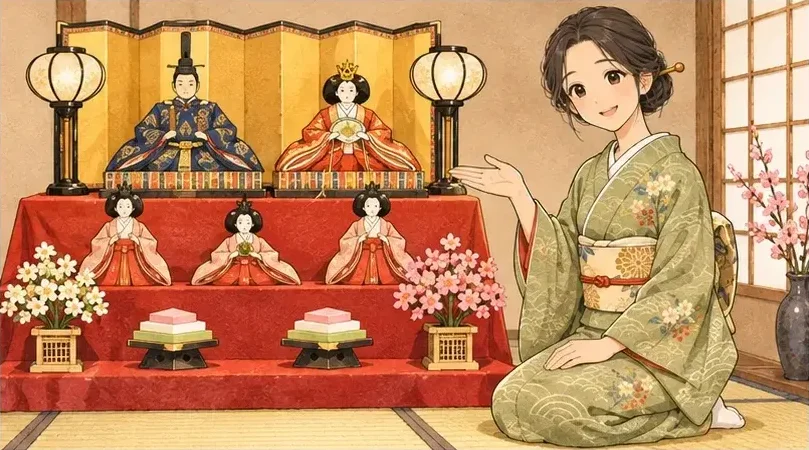
In short: Hinamatsuri (雛祭り), the Doll Festival, is held on March 3. Families with daughters display a set of ornamental dolls dressed as an imperial court, eat colorful seasonal foods, and pray for the girls’ health and happiness. It’s also called Momo no Sekku, the Peach Festival.
Where the festival comes from
Hinamatsuri grew out of two old customs:
- Nagashi-bina (流し雛), “floating dolls.” Since ancient times, people believed bad luck and illness could be transferred into simple paper or straw dolls. The dolls were then floated down a river, carrying misfortune away. Some shrines still hold this ceremony today.
- Hiina-asobi (ひいな遊び), “doll play.” Girls of the Heian-period court (794–1185) played with small paper dolls and doll houses.
Over the centuries, the dolls stopped being thrown away and became treasured ornaments. By the Edo period (1603–1868), wealthy families displayed elaborate tiered sets, and the custom spread across Japan.
Who’s who on the hina display
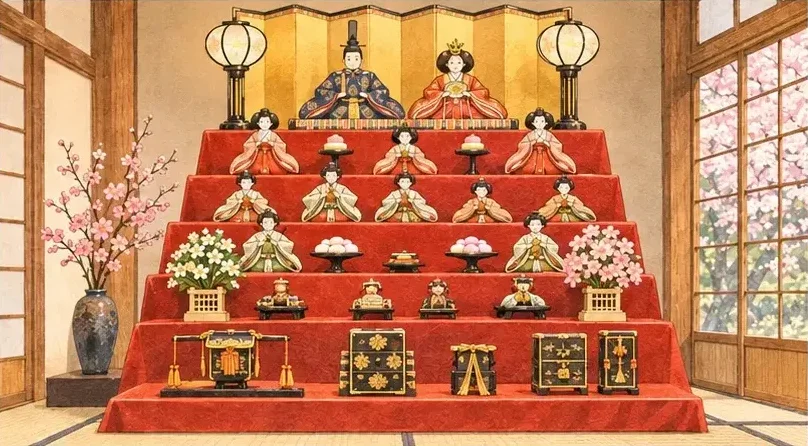
A full set has up to seven tiers covered in red cloth. From top to bottom:
| Tier | Dolls | Who they are |
|---|---|---|
| 1 | Odairi-sama & Ohina-sama | The emperor and empress |
| 2 | Sannin-kanjo | Three court ladies, serving sake |
| 3 | Gonin-bayashi | Five musicians with drums, a flute and a singer |
| 4 | Zuishin | Two ministers — a young one and an old one |
| 5 | Shicho | Three servants |
| 6–7 | Dogu | Miniature furniture, a palanquin and an ox carriage |
Most homes today choose a smaller set: just the emperor and empress, or a three-tier version.
Koto’s tip: Look at which side the emperor sits on! In the Tokyo style he sits on the left as you face the display; in the traditional Kyoto style he sits on the right. Both are correct.
When to set up — and why to put them away quickly
Families usually set up the dolls from mid-February, often around the start of spring in the traditional calendar, and take them down soon after March 3.
There’s a well-known superstition that leaving the dolls out too long will delay a daughter’s marriage. Whether or not people believe it, most families pack them away promptly — on a dry, sunny day, so the dolls stay in good condition for next year. Many sets are handed down from mother to daughter, or given by grandparents when a girl is born.
What people eat on Hinamatsuri
- Hishi-mochi (菱餅): diamond-shaped rice cakes in pink, white and green layers. One common explanation: green for new growth, white for snow and purity, pink for peach blossoms.
- Hina-arare (雛あられ): small puffed rice crackers in spring colors, lightly sweet or savory depending on the region.
- Chirashi-zushi (ちらし寿司): “scattered sushi” — sushi rice topped with colorful ingredients like egg ribbons, shrimp and snow peas.
- Hamaguri clam soup (蛤のお吸い物): a clam’s two shells fit only their own pair, so clams symbolize a happy, well-matched marriage.
- Amazake or shirozake: a sweet, cloudy rice drink. Amazake is usually non-alcoholic, so children can join in.
Koto’s tip: Peach blossoms are the flower of the day. They bloom around this time in the old calendar and were believed to keep evil away — so you’ll often see a branch beside the dolls.
Is Hinamatsuri a holiday?
No. It’s a family celebration, not a national holiday, so schools and offices are open. Its counterpart for children in general — originally boys — is Kodomo no Hi (Children’s Day) on May 5, which is a public holiday.
How to celebrate Hinamatsuri at home
- Display a doll or two. Even a small pair on a shelf with a peach or cherry branch looks lovely.
- Make chirashi-zushi. Season cooked rice with sushi vinegar and top it with whatever looks springlike — egg, shrimp, peas, salmon roe.
- Serve something pink, white and green. Mochi, cookies or even a layered jelly.
- Put the dolls away on time — the next sunny day after March 3.
FAQ
Is Hinamatsuri only for girls? Traditionally it celebrates daughters, but many families simply enjoy it as a spring festival with everyone.
Why are hina dolls so expensive? Traditional sets are handmade by specialist craftspeople, with silk costumes and carefully painted faces. A full seven-tier set can be a major family heirloom.
Can I see big hina displays in Japan? Yes. In February and March, many towns, museums and hotels hold large displays, and some towns hang strings of handmade fabric ornaments called tsurushi-bina.
Related
- Seasonal Calendar — what Japan celebrates each month
- Setsubun: Why Japanese People Throw Beans at Demons — the festival a month earlier
- Sakura Season Treats — pink sweets for spring
Our picks
Compact hina doll set (emperor and empress)
A small two-doll set fits on a shelf and takes minutes to set up — the easiest way to celebrate in a small home.
Best for: Families with daughters, or anyone who loves Japanese crafts
View at Amazon →Hina-arare (colorful rice crackers)
The classic Hinamatsuri snack: tiny, lightly sweet puffed rice in spring colors.
Best for: Trying the festival flavors at home
View at Amazon →Japanese snack subscription box
Spring boxes often feature sakura and Hinamatsuri-themed sweets from small Japanese makers.
Best for: A seasonal gift
View at Bokksu →